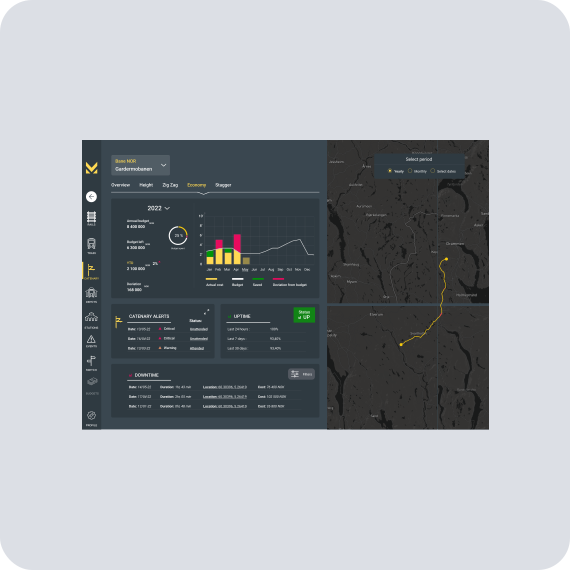
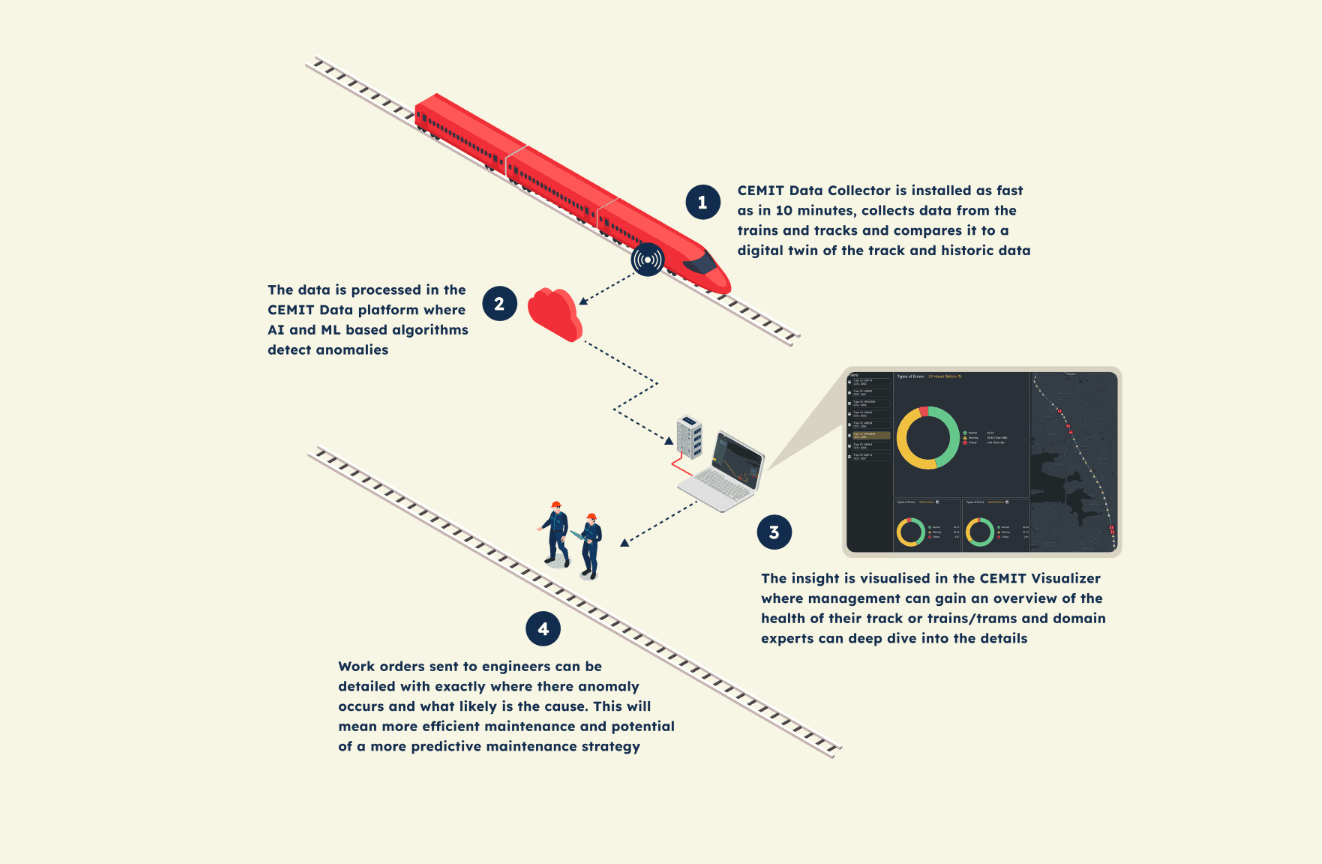
The client CEMIT Group Intelligent Railway system provides its clients a holistic predictive maintenance system which could be utilised by engineers and maintenance professionals in the decision-making support process to achieve effective operations of rolling stock and its infrastructure. The visualizer is an intuitive data dashboard that gives real time insights inc. rail prediction, catenary prediction, train prediction, depot management and route planner.
My role
Supporting with a user-centered approach through research, analysis and design
Team
1 Project Manager
1 Solution Architect
1 software engineer
4 x SME's (engineers)
1 UX designer
Tools
Timeline
The end goal with the system is to provide its clients (within railway, infrastructure and maintenance) with a holistic predictive maintenance system which ultimately reduces the high expenses.
Based on client needs, CEMIT's goal of this project were to further develop existing features, as well as developing and designing new features. The main features are; switch (point machines), depots, catenary, stations, rails, train & work planner.
Being able to move from a planned maintenance system and budget, to a more dynamic predictive system based on sensors and cameras.
Stakeholder interviews with existing customers, internal resources and investors
User interviews with railway engineers, railway system engineers, maintenance managers, maintenance planners, area managers
Research into European technical regulations (BANE NOR)
Research revealed several problem areas, needs and functional requirements;
High costs associated with maintenance costs of rolling stock and infrastructure
Every 20 000 km, the wheels on the trains needed to be scheduled for maintenance, however, the actual need for maintenance would depend on how many millimeters the wheels had worn and torn. In some cases there was actually no need to change them as the condition was good, however that was already too late as the train were already at the maintenance station and the weight for inspection. If the train could go 120 000 km instead of 20 000, the savings would be significant and the wheel maintenance could be scheduled ad-hoc based on sensors and measures
Bybanen in Bergen experienced technical issues and risks related to the catenary, a way to monitor the condition of the catenary without having people out in the field were needed
The need to move away from a planned maintenance system and budget to a predictive system to reduce high maintenance costs
A need to translate the alerts on the catenary, track guage, rail cants, depots, switches (point machines) on different railway lines into a maintenance planner
A need to view maintenance history
A need to separate the work order types to either be (1) Corrective, or (2) Preventive
A need to see all costs related to maintenance
A need to see the Maintenance planner is a calendar perspective
All alerts introduced in the traffic light system must have thresholds from the European technical standards
All alerts must be actionable
The railway and infrastructure industry needs to transition from reactive, schedule-based maintenance towards a predictive and sensor-driven predictive maintenance system, so that high maintenance costs and operational inefficiencies are reduced.
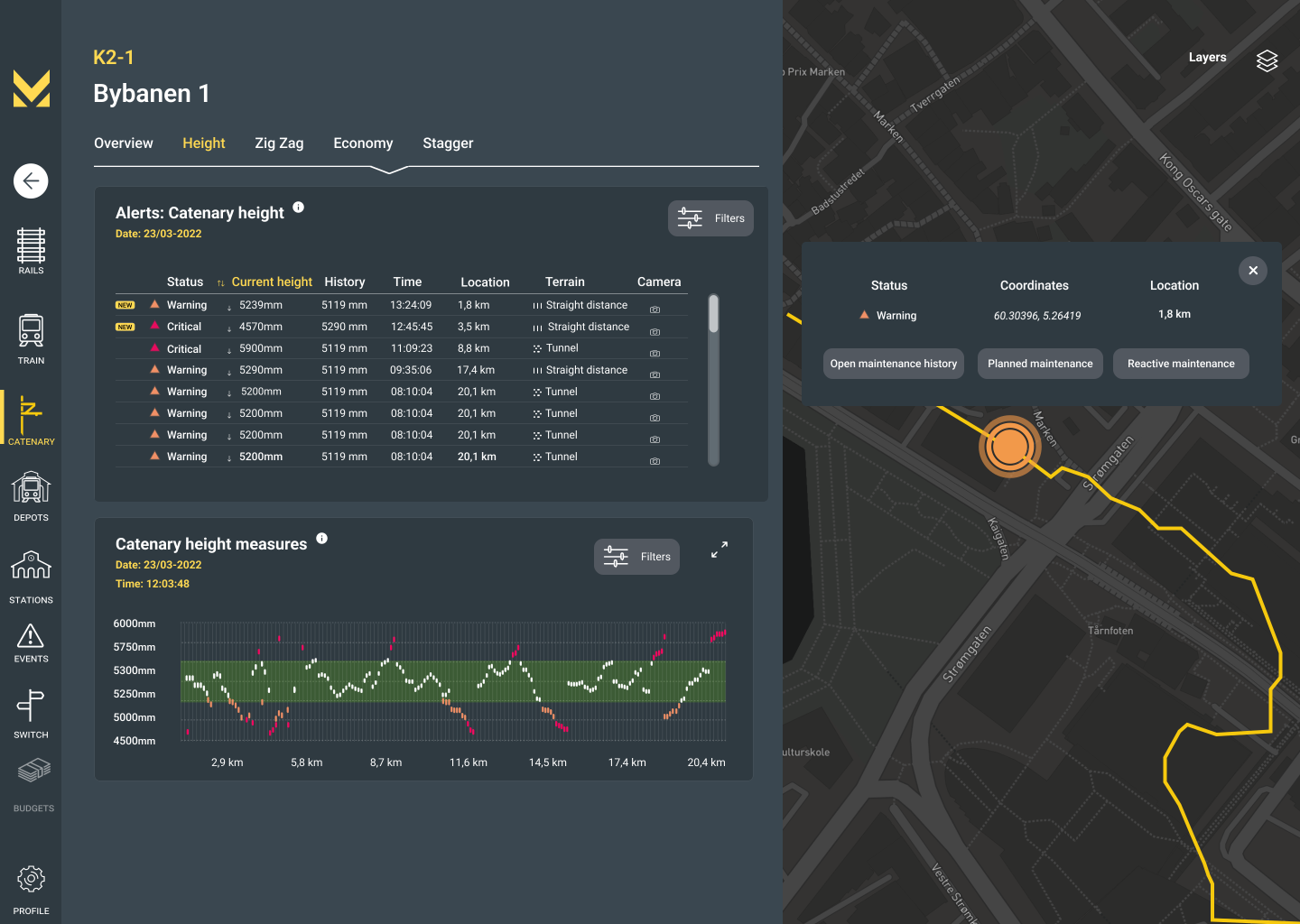
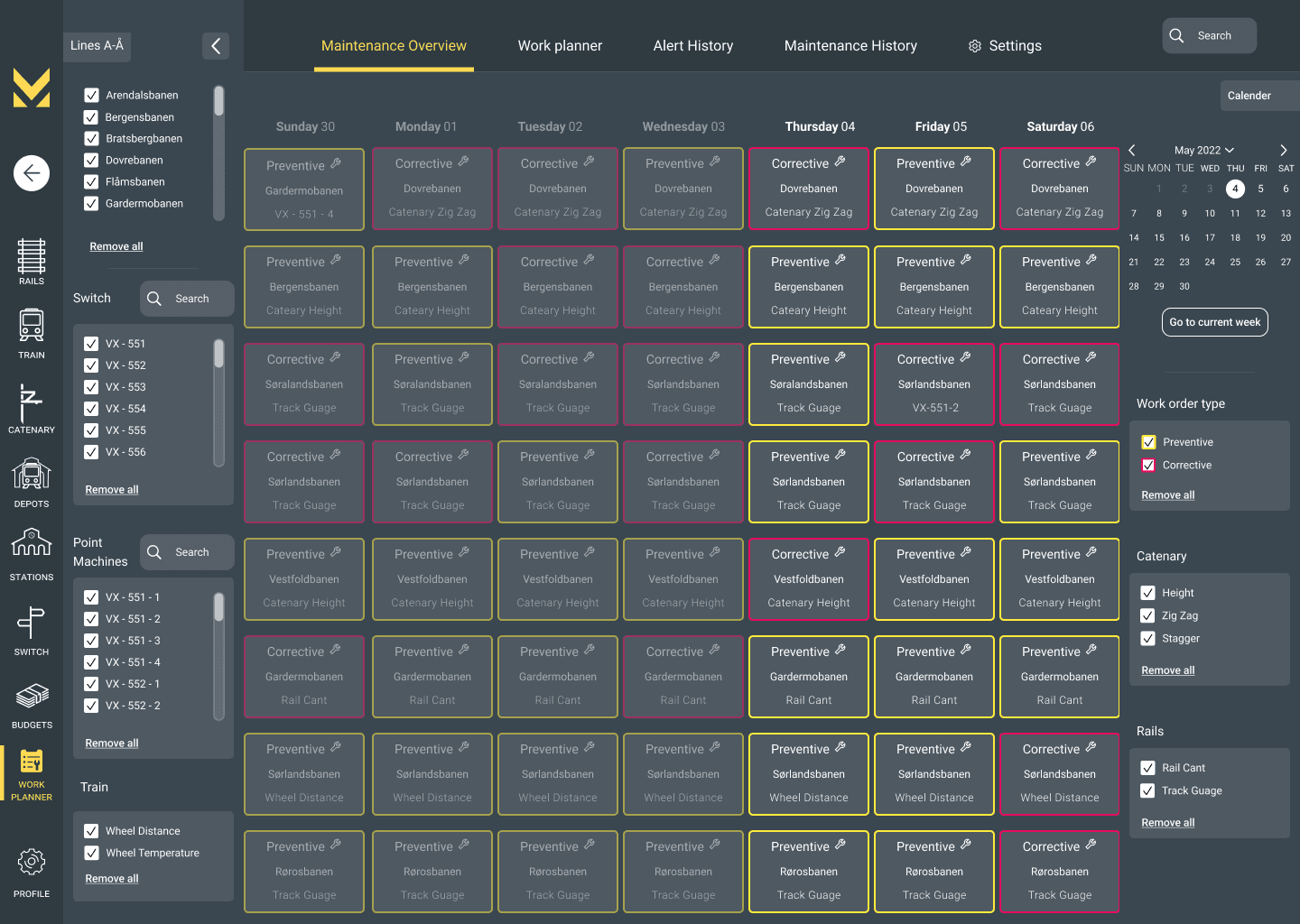
The research based on the proposed solutions provided by CEMIT shows a potential of improving maintenance costs with 30 %, increase up-time by 5 % and improve ride quality by more than 10 %.
Stepping into the railway and infrastructure industry was first of all very challenging as I found myself reading very heavy technical requirements documents on rules, regulations and standards within the industry in Europe. Complex problems definitely required complex solutions, which CEMIT really succeeded in providing. Often having access to the professional knowledge and the end-users is somewhat limited, however the people who founded and was part of the business was people with 20 years experience in this field who had seen the problems first hand. They had seen and experienced the gap that they were all passionate about to fill with CEMIT.